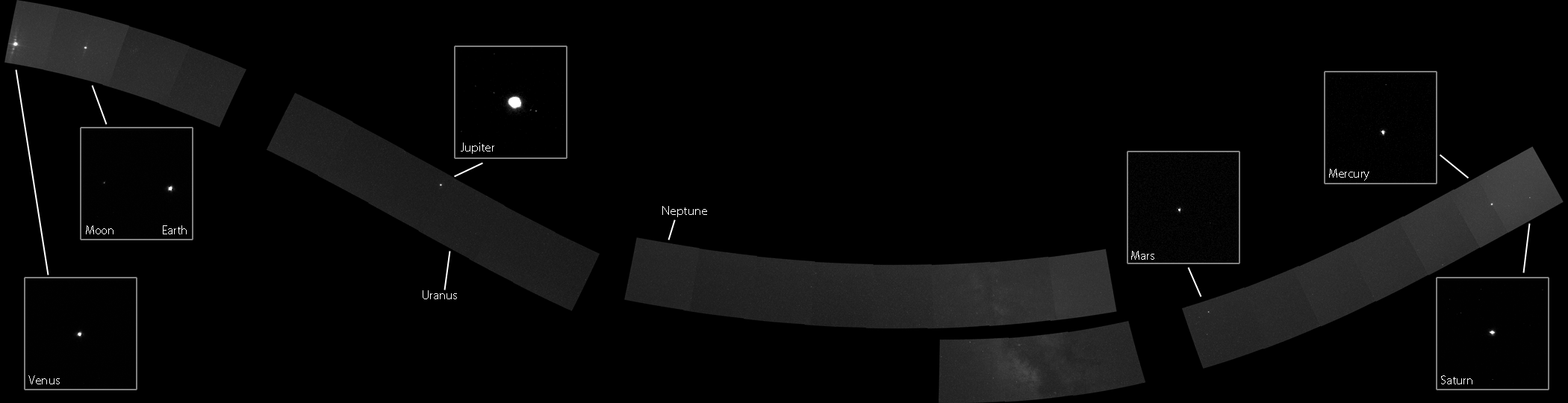
The Messenger space craft is now orbiting the sun at the same distance as Mercury. From its location, we can see the solar system from it's vantage point in this image: Solar system from Messenger
All of the planets out to Saturn are visible in the image, and the zoomed shots can even see Earth's moon and all four Galilean Satellites. Quite the impressive telescope mounted on that craft. By the looks of the image, if the cloud in the same piece of the image as Neptune's location is the Milky Way, the ecliptic is very heavily inclined to the rest of the galaxy. Almost perpendicular.
Friday, February 25, 2011

Friday, February 18, 2011
APOD 3.4
Geronimo! That's quite a long drop.

This is quite a bit different from the mostly liquid water...observatories? Doesn't seem like the correct term. The idea is the same: Neutrinos that have been sent from space, namely the sun, will pass right through most surfaces, but the few that ricochet off the ice can be measured by large light detectors that are strung together in that cable. These holes in the ground are in Antarctica, hardly the most hospitable place, but at least the ice isn't going anywhere until global warming kicks in.
although on that note, fun fact: the ice caps melting lets the freshwater into the sea, messes with currents, and somewhere along the way, supposedly, this alter the weather to actually start cooling everything. Invest in a company that makes Parkas.

This is quite a bit different from the mostly liquid water...observatories? Doesn't seem like the correct term. The idea is the same: Neutrinos that have been sent from space, namely the sun, will pass right through most surfaces, but the few that ricochet off the ice can be measured by large light detectors that are strung together in that cable. These holes in the ground are in Antarctica, hardly the most hospitable place, but at least the ice isn't going anywhere until global warming kicks in.
although on that note, fun fact: the ice caps melting lets the freshwater into the sea, messes with currents, and somewhere along the way, supposedly, this alter the weather to actually start cooling everything. Invest in a company that makes Parkas.
Friday, February 4, 2011
APOD 3.3
Oh boy! Exoplanets! When I had done my exoplanet quarter project, I had found many worlds that I declared "poor real estate." Never did I find a group like the 6 worlds around Kepler-11 where they are all closer to their star than Mercury is to ours. All terrestrial and found with the transits system to boot. We're not going to find another Gliese-581G that close to a sun-like star, though, but with the Keplar telescope having found 1200 planets in a portion of only 1/400th of the sky, we should be able to find another habitable world someday. Getting there is another story. See ya then, Vulcans.
Friday, January 21, 2011
APOD 3.1
A new quarter, and the start of a new constellation chart. Timely enough, the stars of Orion's belt: Alnitak, Alnilam, Mintaka are pictured here, in all their unstable blue super-giant glory. Also beneath Alnitak, one can see the star that makes the sword attached to Orion's belt. Looking just here One can see multiple nebulae, including the Horse-Head Nebula, the Flame Nebula, and of course, the Orion Nebula.
Friday, January 14, 2011
John Frederick William Herchel
John Frederick William Herschel, born in 1792, was the only son of William Herschel. He wrote many papers on meteorology, the telescope, and physical geography. He was one of the few scientists to be motivated to enter science by his family than political events. He studied at Eton College and St. Johns College, and graduated in 1813. In 1816, he built a reflecting telescope with a mirror 18 inches in diameter, and a focal length of 20 feet. With the aid of James South, He re-examined the double stars catalogued by his father. For this work, he was presented with the gold medal of the Royal Astronomical Society in 1826 (a medal he would win again in 1836).
In 1831, his A preliminary discourse on the study of natural philosophy was published. The book was intended to set guidelines for scientific exploration, linking observing and theorizing. He also stated that the highest point of philosophy was taking observations and confirming their connection with a single phenomenon. This authoritative statement would later influence Charles Darwin “with a burning zeal” for his own work.
Herschel published, in 1864, a catalog of his fathers work fused with his own. General Catalogue of Nebulae and Clusters was the written expansion to his father's book, Catalogue of Nebulae.
APOD 2.8
The cosmic web of the tarantula nebula is a massive star 'nursery' orbiting the milky way galaxy. Were it as close as the Orion nebula, it would appear sixty times as wide as a full moon. The nursery is a producer of very large stars, which have shorter life spans than most. As a result, the nebula is home to a fairly recent supernova.
As luck would have it I actually had a pet Chilean rose-haired tarantula (or Chilean common tarantula) for a year. Interesting creatures. But I can help being perturbed by the title of this picture. Tarantula's do produce silk like all spiders but do not spin webs. (yes I can be petty!)
As luck would have it I actually had a pet Chilean rose-haired tarantula (or Chilean common tarantula) for a year. Interesting creatures. But I can help being perturbed by the title of this picture. Tarantula's do produce silk like all spiders but do not spin webs. (yes I can be petty!)
Wednesday, January 12, 2011
images of a mass of incandecent gas
http://www.brevardastro.org/albums/UniverseScale/photo3.html I put the whole set up. Creates a very good sense of scale throughout the set. Antares is massive compared to our yellow star.
http://www-istp.gsfc.nasa.gov/istp/outreach/images/Solar/Educate/features.jpg Though disappointingly not labeled as such, an image I believe to have been taken in Ultraviolet. Confirm this I can not.
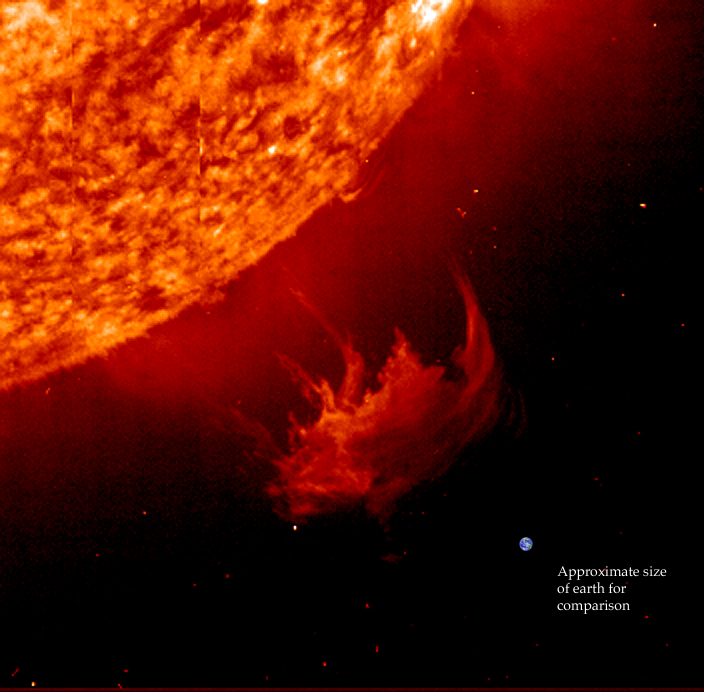
http://www.astronomy-pictures.net/sun_and_earth.jpg The coronal mass ejection that could kill us all, with a photoshoped in Earth for scale.
http://www.nasa.gov/mission_pages/stereo/news/stereo3D_press.html series of photos in false color from all wavelengths from the STEREO satellite.
http://scienceblogs.com/startswithabang/upload/2010/08/from_the_sun_to_your_sky_in_ju/239ed_2010-06-16-sun_coronal_mass_ejection.jpeg A visual representation of how our magnetic field keeps us from being easy-bake-ovened by Coronal mass ejections. Explanation here
http://memebase.com/2010/12/01/memes-very-demotivational-sun-i-am-disappoint/ A more humorous demonstration of scale between our sun and other stars. Not counted as one of my images as it's mainly here for a humorous reason than any spectacular. Particularity amusing for those Familiar with internet culture. Potentially disappointing for others.
http://www-istp.gsfc.nasa.gov/istp/outreach/images/Solar/Educate/features.jpg Though disappointingly not labeled as such, an image I believe to have been taken in Ultraviolet. Confirm this I can not.

http://www.astronomy-pictures.net/sun_and_earth.jpg The coronal mass ejection that could kill us all, with a photoshoped in Earth for scale.
http://www.nasa.gov/mission_pages/stereo/news/stereo3D_press.html series of photos in false color from all wavelengths from the STEREO satellite.
http://scienceblogs.com/startswithabang/upload/2010/08/from_the_sun_to_your_sky_in_ju/239ed_2010-06-16-sun_coronal_mass_ejection.jpeg A visual representation of how our magnetic field keeps us from being easy-bake-ovened by Coronal mass ejections. Explanation here

http://memebase.com/2010/12/01/memes-very-demotivational-sun-i-am-disappoint/ A more humorous demonstration of scale between our sun and other stars. Not counted as one of my images as it's mainly here for a humorous reason than any spectacular. Particularity amusing for those Familiar with internet culture. Potentially disappointing for others.
Subscribe to:
Posts (Atom)